
..........................................................................................................................................................................................................
new bike day
apparently, and unbeknownst to me, it appears that wednesday 20 august was new bike day if my e-mail inbox was anything to go by. not even midway through the day, colnago announced the unveiling of the c68 rossa, a smartly red decorated carbon bicycle which is (every day's a schoolday) positioned as the official bike of this year's vuelta, a bestowance that is every bit as pointless as a penguin on a bike. only 90 of these will ever exist, though at £19,900 each, you'd have to be a real enthusiast for both spain and colnago to hand over the readies. however, it didn't stop there; ever since they introduced their wireless 13-speed groupset, campagnolo have been drip-feeding individual bicycles, built-up with their shiny new gears and brakes. perhaps fortunately, there appears to have been no price tag attached to this week's bicycle (drali).
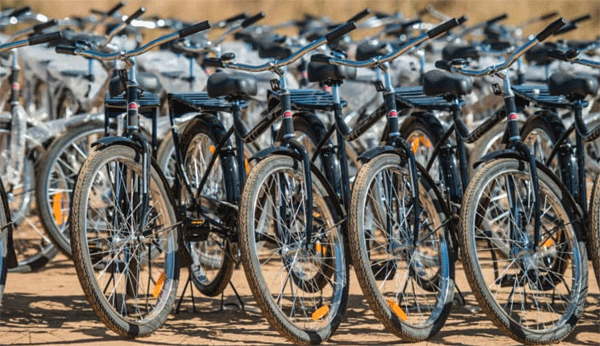
however, as the result of an entirely different trajectory, a further e-mail detailed a bicycle that pretty much sits at the exact opposite end of the spectrum to either of the two detailed above, but in truth, a bicycle that carries a far higher degree of importance than the flimsy carbon fibre that attracts such inflated prices. in fact, this particular example of velocipedinal delight costs a mere £120 and is currently available in a limited edition of 906,000. we're talking about world bicycle relief's buffalo bike, a sturdy machine that has made such a huge difference to thousands of african lives.
world bicycle relief won a eurobike award last year for the second iteration of their buffalo bike, the utility s2, a variation which now features two chains, two sprockets on the back wheel and a simple back-pedalling movement to switch between the two. this allows the rider to cope with the less than pristine terrain across which the majority of these bikes are ridden. and while colnago trumpets the c68 rossa as being very much of the 21st century, i asked wbr development and engagement manager, thomas richards, when and where the first buffalo bike was made? is it also of the 21st century?
"The first Buffalo Bicycles were produced shortly after World Bicycle Relief was founded in 2005, but in 2010, the design was updated and unified into a single, gender-neutral frame, created in collaboration with Giant Bicycles, to improve accessibility and durability. Today, the Utility S1 continues to be produced at scale, remaining the backbone of WBR's bicycle programs with the utility S2 being introduced to our programme countries this year."
without wishing to harp on about the wide differences between world tour carbon and the sturdiness espoused by a bicycle named after the animal whose strength it closely resembles, the buffalo is designed to withstand the slings and arrows of african discontent. but was it, in fact, designed to equal the terrain by virtue of its impressive sturdiness, or was there careful research undertaken to identify the ultimate bicycle for the task?
"The Buffalo was never just a matter of finding a sturdy off-the-shelf option. From the beginning, WBR undertook years of research and development, testing bicycles in rural Africa, gathering rider feedback, and refining the design to meet the realities of everyday use. The result is a purpose-built bicycle, designed specifically to survive punishing terrain, carry loads of over 100 kilograms, and remain serviceable with the most basic of tools. Unlike commuter or leisure bikes adapted for other markets, the Buffalo was engineered from the ground up to meet the specific challenges faced by people in rural communities."
as thomas alluded to above, the original bicycle, the utility s1 is not only still in production, but forms the 'backbone' of wbr's donation programme. however, if the latter has proved its worth and longevity in the face of the contemporary frippery enjoyed by you and i, what brought the need for a second version?
"The Utility S2 represents both a natural evolution of the S1 and a strategic response to the needs of riders in different terrains. Many users expressed the need for gears to help when carrying heavy loads, tackling hilly routes, or navigating busier roads. In response, WBR engineers developed a patented two-speed drivetrain that is simple, durable, and redundant, with two chains so that the bike can still be ridden even if one fails. This system makes climbing easier, reduces strain when starting under load, and improves control on loose or uneven ground, making it more versatile for a wide range of conditions."
if you've cast even a cursory glance at the world bicycle relief website, you'll surely have seen what passes for road infrastructure in certain parts of deepest africa. while we live in a society where over 70% of all car journeys are of less than five miles, those in such regions have a far stronger work ethic and survival instinct, coupled with the glaringly obvious fact that driving a car (let alone owning one), is simply not an option. in western commerce, there's a strong likelihood that the emergence of a new bike would immediately supplant its predecessor. so why the two versions?
"The S2 is not a replacement for the original S1. The single-speed S1 continues to be the primary model in production for 2025-2026, and it remains well-suited to the conditions in many of WBR's program areas. Both versions are available, and the decision on which to supply is made by country teams, based on local terrain, the target population, and sector priorities. Over time, if demand for the S2 grows significantly, some regions may choose to transition fully to the new model, but this will be a market-driven decision rather than a top-down replacement."
all well and good and, if i might point out, quite logical. but to look a tad more closely, how does wbr decide which of the two is the more appropriate choice?
"The choice between the S1 and S2 is determined by practical factors. The S2 tends to be favoured in areas with hilly terrain, where riders often carry heavy cargo, or where additional gearing can reduce strain for older riders. The S1, however, remains the simpler and more cost-effective option, requiring less maintenance and performing well in flat regions. Ultimately, country teams evaluate local needs and decide which model best serves the communities they support, with the S1 continuing as the default option unless the S2 offers clear advantages."
release of a new bicycle targeted at you and i, is almost certain to contain as many new features as possible, whether those features have any intrinsic value or not; an attempt to convince that we're receiving value for money. it's a state of affairs that is endemic in modern, western society, where reputedly at the behest of customer demand, spurious new features are included in software, white goods, mobile phones and even foodstuffs, even if the previous version was perfectly adequate. the software i use for my daily work now includes the ability to engage with artificial intelligence, even though i never asked for it, and have ignored every opportunity for its use. it seems prudent, therefore, to ask if the utility s2 has proved every bit as good as hoped for?
"Early results show that the Utility S2 has been highly effective. It has already won international recognition, including Eurobike and German Design Awards, for its innovative and robust design. Field testing confirms that the second gear provides real benefits for riders, particularly when hauling heavy loads or climbing hills, and the redundant drivetrain ensures the bike maintains Buffalo's reputation for reliability in harsh conditions. Monitoring and evaluation are ongoing through data collected via Buffalo Shops and programme integration, and WBR is continuing to study the long-term impact of the S2 throughout this year, with results to be shared in the future."
molds for carbon monocoque frames are expensive, probably ensuring that, once created, variations are likely kept to an absolute minimum. unless, of course, market research indicates otherwise. thomas has indicated that the utility s2 is currently undergoing monitoring and evaluation, which might indicate that, far from being set in stone, the buffalo s2 is under constant revision.
"The design of the Buffalo Bicycle is indeed under constant development and is far from fixed. Every generation of the bike has been refined based on rider feedback, mechanic reports, and field testing. WBR's product development team, which includes some of the most experienced minds in the cycling industry, works continuously to improve the bicycle so that it best serves the needs of its riders. The move to a single universal frame in 2010 and the introduction of the S2 drivetrain are both examples of this ongoing evolution. WBR is committed to continuing this process, ensuring that the Buffalo Bicycle remains a reliable and indispensable tool for the communities that depend on it."
while you've been reading the above, i have employed my calculator to work out that for the price of one colnago c68 rosso, world bicycle relief could provide almost 166 buffalo s2 utility bikes to those considerably less fortunate than ourselves. if colnago sell all 90 of them, they'd earn sufficient cash to provide 14,920. might i humbly suggest that, if you have the ready cash to purchase one colnago c68 rosso, that you instead click the link below and donate the money to world bicycle relief? and even if you're a long way from acquiring cambiago's finest, please donate whatever you can.
the world will be eternally grateful.
donate to world bicycle relief
thursday 21 august 2025
 ..........................................................................................................................................................................................................