
..........................................................................................................................................................................................................
why?

those injections taken predominantly by women to lower their weight, have now become available as a course of tablets, providing the same weight-reduction benefits to those less inclined to use a needle. i was, however, surprised to learn the cost of undertaking a course of these medications, which, according to a report in saturday's guardian newspaper, could exceed £3,000 per year. the fact that so many are willing to accede to that level of expenditure, if nothing else, proves that human beings still favour the easy way out of everything. even if it costs a lot of money.
my regular accompanist on the sunday ride suffers from high blood pressure, but has learned that he need only go for a bike ride to bring it back to acceptable levels. and that bike ride need not exceed 16km. as surprised as was i, he has spent a couple of weekends verifying this state of affairs, and it would seem to be confirmed for him at least. which not unnaturally brought the conversation around as to why more folks on a lightly populated island such as this, do not cycle more? or, in the majority of cases, cycle at all.
even when bicycles can cost a lot less than a course of weight-loss drugs.
there are the perpetual naysayers, who think us crazy to go cycling in all weathers, particularly when there is no pressing need to go anywhere at all. as i have constantly repeated, we're only riding round in circles before heading home for a shower and a change of clothes. granted, there are occasions when i have arranged to be somewhere in order to write an article for the newspaper, but i have usually checked the forecast in advance, thus ensuring no requirement to don waterproofs. as to the sunday ride, where's the point in owning such a wide range of weatherproofing if i never cycle in the rain?
i can, therefore, understand why the average non-believer would hesitate to cycle anywhere, when they could arrive warm and dry by car. yet, for all the hoo-ha that accompanied closure of the strait of hormuz, and the rapid increase in fuel prices, i noted no discernable change in folks' transportation habits. islay's public transport is confined to a bus service that falls well short of the word comprehensive. depending on where you live and at what time you start work, you could find yourself arriving unfavourably early, or unfashionably late. yet, considering the incomparable lightness of traffic, allied to relatively short distances, there has been no observable increase in cycle-commuting on the island.
the question, therefore, remains; why?
when i first arrived in the hebrides almost forty years ago, i asked the same question, the standard answer to which was 'the wind'. it's an undeniable fact that, despite an increase in easterly winds in recent years, a rock on the edge of the north atlantic was always going to find itself at the behest of sturdy draughts. even this past weekend, when the sun has been splitting the paving stones, there has still been a persistent, cooling wind that, on occasion, was found to retard my forward motion more than i'm willing to admit. do not misunderstand me; onerous or otherwise, those winds offer welcome respite from what passes for a heatwave in the hebrides.
yet, with two e-bike hire outlets on the island, and no shortage of visiting takers for their services, it appears that few, if any, locals are keen to join their ranks. as the ageing process takes its toll, my top speed is considerably lower than was once the case, and i frequently find myself huffing and puffing on the ascents, short and sharp though they might be. but i am still faced with the naysayers, convinced that they'd struggle to keep up, were they to join the happy throng. but that is something of a misnomer, because rarely am i attempting to recruit to the sunday ride; in the majority of cases, i am simply suggesting a means of keeping reasonably fit, of regulating any weight gain (or loss), all the while reducing unwarranted financial outgoings.
well do i know that this is not a situation exclusive to the hebrides. with larger populations, the percentage riding bicycles is bound to be higher, but considering that we have no pedestrian crossings, no roundabouts, no traffic lights and no one-way road systems, it is surely the ideal location in which to cycle without undue concern over road safety? granted, the winds will always be a feature not a bug, but it doesn't take too long to become accustomed to their persistence. if nothing else, they reward with improved fitness.
cycling cures everything; how come we're the only ones who know that?
monday 13 july 2026
 ..........................................................................................................................................................................................................
missing the action
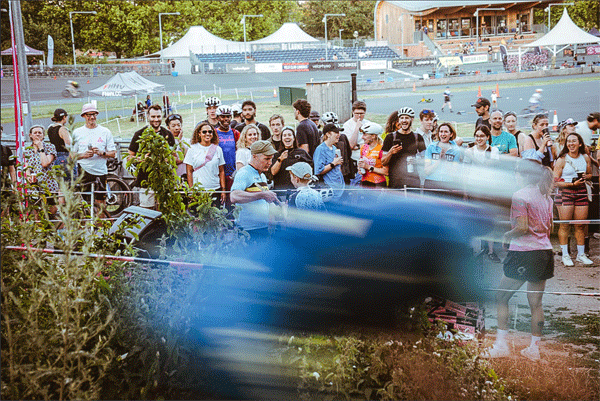
so far, two rounds of rapha's summercross season have been completed, out of the four being held at herne hill, with a fifth round in mid-august destined for the cyclopark. despite that professional cyclocross has long campaigned to be included in the winter olympics, because the continental season extends from october through to february, i have often thought that there could just as easily be a summer season of cyclocross. granted, in the record-breaking temperatures that seem to be a recurring feature of each year, there would likely be a lack of mud and a consequent reduction in the number of karcher washers required, but the few north american events i have witnessed on the tellybox, if nothing else, surely prove that it's still a viable outpost of cycle sport without the gloop?
and, if we're all perfectly honest, a majority of rounds comprising the super prestige, x2o badkamers, exact and world cup competitions over the course of the 25/26 season were presented virtually mud-free. in fact, in a glorious moment of irony, sometimes the only muddy sections are those adjacent to the pits, caused, inevitably, by teams' use of the karcher pressure washers mentioned above.
for those of us (and i use the plural purely to dispel any feelings of isolation) in thrall to the finest branch of cycle sport, there are still about four months of road-racing to suffer before we can return to middlekerke, overijse, hulst, hoogerheide, to name but a few, and to which must surely be added, glasgow's kelvingrove park which, almost inexplicably, will host a round of the uci world cup series on sunday 13 december, for which the 'cross-obsessed members of the velo club have already purchased the necessary tickets. now we witness, with considerably less glee, the price of glasgow hotels these days (and nights). it's entirely possible that i may need to impose upon my daughter and son-in-law's couch for an evening.
while cycling's media outlets - with the exception of thewashingmachinepost - revel in the minutiae of those three weeks in july, followed eventually by three weeks of the spanish tour, a few one-day races and the world championships, i am entirely guilty of wishing my life away, keen to get the above over and done with so that i can concentrate on cyclocross all the way to next february. i have no doubt that the ceo of tnt sports eagerly awaits the opportunity to extort another large tranche of money from my paypal account as i help it subsidise the obscene amount of money paid to televise british football/soccer. but as john wayne once said, "a man's gotta do, what a man's gotta do" (a phrase that presumably applies equally to the fairer sex).
if you haven't experienced european cyclocross in all its weekly glory, accompanied by big bobble hats and a beanie with a duck's beak on the front, you really don't know what you're missing. though i will accept that friends and colleagues who consume alcoholic beverages have been saying the same thing to me since art school. take my word from it; 'cross is where it's at, and it simply can't come quick enough.
image: rapha | rapha summercross
sunday 12 july 2026
..........................................................................................................................................................................................................one of these things is not the same
unless you're in the habit of dropping your bike into the local bike store whenever a puncture has reared its ugly and unwanted head, you may be familar with the 'bump, bump, bump of front or rear tyre on fitting a new tube. invariably that's because the tyre bead hasn't seated correctly at the valve, and you didn't notice when refitting the wheel to the bike. we've all been there. however, over the past couple of weekends i became aware of a similar sensation emanating from the rear wheel, particularly noticeable when descending smoothly tarmac'd hills (which are, admittedly, few and far between round these here parts).
the difference with this situation is that the rear tyre has been in place for months, so it seemed that the fault may not lie with the mechanic (me). however, each time i dismounted and spun the wheel, there seemed nothing awry, and the bead appeared to be correctly seated around the entire circumference. lest my sensitivity misled me, i also checked the front tyre, but once again, all was in order.
now, for a number of months there has been a few millimetres of lateral play in the rear wheel, which i surmise is the result of worn bearings. these are not new wheels. however, since i have plans to purchase a new set of wheels in the fullness of time (whenever i get a round tooit), and the play is hardly onerous at present, i figured i could live with it for a few weeks more. however, when lifting the bicycle from thewashingmachinepost bike shed on friday, with the intent of cycling south west to debbie's for coffee and a toastie, i figured it wouldn't do any harm to have a closer look at the challenge chicane rear tyre.
disappointingly, i found a one centimetre split betwixt the tread and the sidewall casing; not necessarily of immediate concern, but just as wile-e-coyote never falls until he realises he's in mid-air, i figured that a puncture loomed in the immediate future now that i was aware of the problem. and, to be honest, i'd have thought of little else while riding on friday and the remainder of this weekend. unfortunately, islay is not blessed with a nearby bicycle shop that might stock a suitable replacement, so i had a quick scrabble about the bike shed to see what might have been unceremoniously discarded in previous months/years.
though i did not have anything suitably cyclocross, i did have a challenge strada 700x33c road tyre lying unceremoniously over the top tube of one of my other bikes. and despite the tread showing a bit of wear, the carcass seemed prudently intact, so i removed the chicane tyre from the front wheel and refitted it to the rear, then placed the strada on the front. as with every challenge tyre i've ever owned, both were absolute bstrds to fit and resulted in a snapped tyre lever and sore thumbs, even with a tyre jack to do the heavy lifting. challenge tyres also have the necessity of having the tyre bead visibly seated around the full circumference of the wheel, a task that inevitably involves over-inflating the tyre to achieve, before dropping the pressure to the recommended 40psi afterwards.
job done, i left the croft over an hour late, in serious need of that toastie and in what passes for a heatwave in the hebrides. joyously, a cooling sea breeze made the trip to bruichladdich quite comfortable, the downside being that i immediately burst into flames when i stopped.
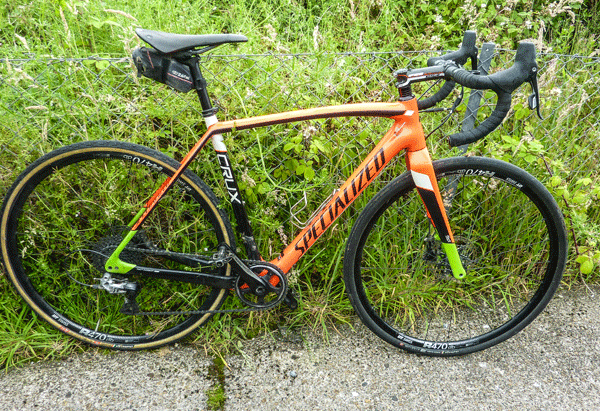
now, despite both tyres featuring the same diameter and tread width, one has a bit of a tread augmented by an amber sidewall which, as we all know, if a few kilometres per hour faster than a blackwall tyre as is now fitted up front. in short, i now have two visibly different tyres fitted to the crux, something that i'm sure will incur the wrath of velominati's rules. however, under the circumstances, what choice did i have? but rules of engagement aside, is there any uci regulation that countermands the fitting of differing tyres to a single bicycle? i fully intend to discount any naysayers by turning it from a bug into a feature, creating a velocipedinal trend of my very own by insisting that jonas and tadej do likewise all the time.
but only until the replacement arrives in the post.
saturday 11 july 2026
..........................................................................................................................................................................................................i robot
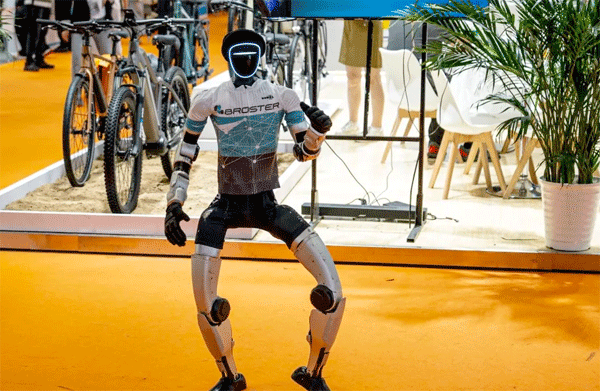
the bbc recently reported on robots for hire, something that, it transpires, is perhaps more prevalent than you and i may have suspected. according to the report, north american hospitals have employed 100 four-foot tall robots from diligent robotics, that their chief operating officer claims have frequently been accepted as "part of the team" by their human colleagues. purchase of such humanoid devices can equal that of a replica of tadej's colnago (£15,000), but as an alternative, several robotics manufacturers have accepted the high price of admission, and offered a leasing alternative closer to £400 per month.
leasees acquire not only the use of a suitable robot, often accompanied by bespoke software to suit whatever application the robot may be required to undertake, but a complete backup service, including a human engineer working remotely, and able to take control over the robot should the need arise. a bit like digital cameras, which, in truth, need not resemble the analogue cameras they have effectively replaced, there is no technical reason why robots need inhabit humanoid form, even in instances where their chores were previously carried out by humans (an argument for another day on a very different blog). however, it is part of the human condition that we find ourselves more likely to sympathetically relate to the human form.
combine recent advances in robotics with similar progress in artificial intelligence, and though the result may not precisely resemble any humans with whom we are personally acquainted, nor equal the wide ranging perspicacity of the average person, when set towards a particular set of tasks, there are undoubtedly advantages to be gained. and when i write 'a particular set of tasks', i use a phrase that could easily be substituted with 'any particular sport'. we have already witnessed the ease with which humanoid robots have run marathon events, arguably quicker and more efficiently than their human counterparts. and if robots can be programmed to run, it's not too much of a stretch of the imagination to contrive that they might just as easily ride/race bicycles.
it's very unlikely that we will ever see robots travelling to work by bicycle, partly because such devices rarely 'live' away from the job, but should that actually come to pass, it would likely be no less practical for them to run or walk. however, consider the possibility of teams of bike-riding robots contesting not only the three grand tours, but any other branch of the sport that was welcoming of the prospect. granted, it is undoubtedly possible that a robotic bicycle could be developed, excluding a robotic, humanoid form in the saddle, but ultimately, where would be the entertainment value in that?
for starters, instead of paying the team leaders the sort of money reputedly flowing into tadej's bank account, cycling robots could be leased. should the team sponsor fail to renew at the end of the season, it would be a simple matter to return the 'riders' to the factory. and the robotics engineer described above as languishing in a remote location, could just as easily be sat in the back seat of the (self-driving) team car, feverishly uploading improved code to have the principal robot reach the finish line ahead of the competition.
a team of robot cycle racers would surely obviate the need for any off-season, for months and months of training and endless honing of nutritional concerns to have the protagonists ingest more than a seemly amount of carbohydrates in order to promulgate victory.
for those who point out that human cycling activity is perpetually susceptible to human failure, thus ensuring an appropriate degree of varied entertainment for a human audience, it is not outwith the bounds of possibility that the uci could mandate the inclusion of randomising computer code, thus ensuring lack of a level playing field. team sky was often criticised for its robotic approach to the tour, as have both uae emirates and visma-lease-a-bike, so a cursory glance at the peloton need not necessarily reveal any noticeable difference.
once again, the more things change, the more they stay the same.
friday 10 july 2026
..........................................................................................................................................................................................................reality bites
there may be a one-off shortening of this year's ride of the falling rain, due to council roadworks that may, or may not, close off the return section from portnahaven. for those unfamiliar with islay's road network, the falling rain usually commences with a short pedal of around 4.5km from debbie's in bruichladdich to the next village south, that of port charlotte. however, midway through the village, we would normally turn right up towards the primary school, heading west for a further five kilometres, before veering left and riding about ten or eleven kilometres to portnahaven. that particular route remains unaffected.
however, the council has intimated that, from 1 august until 30 september, they expect to be carrying out resurfacing work on the return road leading from portnahaven back to port charlotte. i do have my doubts that such works will begin over the course of a weekend, but you just never know. and there's little point in cycling to portnahaven to learn that you might have to return the way you got there in the first place. i might know more nearer the time (sunday 2 august), but for anyone intending to join us for this year's event, it's as well that you know in advance.
road repairs, of course, are hardly unique to islay, but the particular stretch of road outlined above, has been steadily disintegrating for years, sporting hundreds of potholes of varying sizes that might be easier to avoid on a bicycle than in a car, but not by much. therefore, though several residents who live nearby are somewhat dismayed at the lengthy period of time during which they may or may not be inconvenienced, no-one wants to complain too loudly, since it might rival the volume of complaints that have finally brought the council to do something about it.
despite the millions of pounds in alcohol duty that flow from islay's distilleries into the national coffers each year, the island is very poorly served when it comes to maintaining the roads network; the very routes worn to a frazzle by delivery trucks serving the distilleries and visitors ariving by car or motorhome, intent on touring said distilleries. the get-out-of-jail-free card most often played by holyrood and subsequently argyll & bute council, is the truism that all that whisky duty accrues to westminster and not to the scottish parliament. since road maintenance is primarily a devolved activity, it seems that none (or very little) of that money ever makes its way back to the point of origin, by way of smooth tarmac.
in that sense, the infestation of gravel bikes has perhaps arrived at a most appropriate time, with a notable majority of velo club members having parked their road bikes and switched to gravel or cyclocross bicycles, to forestall any bicycle damage, and improve the comfort factor. add in the frequent necessity of pulling off the road onto the verge to allow motor vehicles to pass on singletrack roads, and those wider and chunkier tyres definitely have their place in hebridean velocipedinal culture.
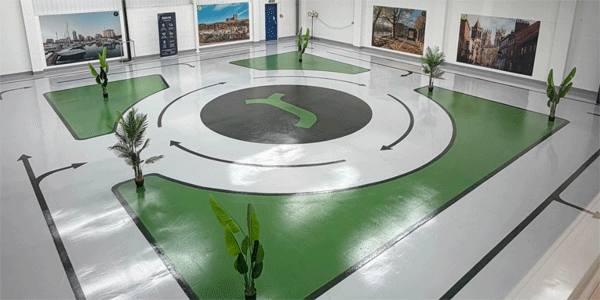
but, perhaps my apprehension that the majority of the country is blighted with demonstrably poor road surfaces is essentially incorrect? jorvik tricycles has just announced the opening of a new, indoor test track in their southampton premises, allowing potential customers to "...replicate real road conditions." if that is indeed true, then i am particularly envious of the residents of southampton, not because they have the chance to test-ride some tricyles, but because labour-run southampton council must surely be immensely proud of its roads department. if andy burnham does indeed become the next leader of the labour party, and subsequently the country's prime minister, i would expect him to immediately make a bee-line for the town in order to personally extend his approbation to the council leader.
should you wonder of the reason for my unsubtle praise, take a look at the (artificial) road surface of jorvik's test track as illustrated at the top of this article. if that does indeed, replicate 'real road conditions', then argyll & bute council has a veritable mountain to climb when resurfacing the road from port charlotte to portnahaven.
thursday 9 july 2026
.............................................................................................................................................................................................................and statistics

i recently attended a meeting of invited individuals at islay's gaelic centre, about half a kilometre outside bowmore village. adjudging it scarcely worthwhile returning home to collect my bicycle and cycle to the venue, i opted to walk. even for an aged chap such as myself, it's not a great distance (probably only a couple of kilometres from the office), but that short walk is made a tad more treacherous by the final half-kilometre being bereft of a pavement. in other words, i'd to walk on the main road leading from bowmore. thankfully, that's not quite as oneroous as it sounds; even at the edge of what passes for summer over here, motor traffic is relatively light, and very likely to behave courteously when passing.
as it transpired, i didn't stay very long. the event celebrated a visit to the centre by the director of bord na gaidhlig, scotland's premier gaelic organisation, responsible for overseeing the funding provided by holyrood, to which i had been invited as a member of the local press. disappointingly, the bulk of the conversations and discussions were held in gaelic, and, as a non-speaker, i had little to no idea of what was taking place, and saw no point in remaining past the introductions (also held in gaelic). so i left.
however, the gist of the meeting, i later learned, was the recognition of islay and jura, within the region of argyll & bute, as areas of linguistic significance, a designation that is apparently triggered when an island or region can demonstrate at least 20 percent of the population has gaelic. the trick, and i'll probably get into bother for saying so, is how that 20% is adjudged. it's a question i was keen to ask after the fact, and the answer to which is, apparently, from the census. however, if i recall correctly, the census question that has subsequently defined this figure, it rather loosely asked if the respondent had any words of gaelic. i do not believe we were asked whether we had any degree of fluency.
like many others, when living in an area where gaelic is still spoken to even a small degree, it's not hard to pick up one or two words that may subsequently be pronounced incorrectly, or even used in the wrong context. or otherwise. it strikes me, however, that defining an area as of linguistic significance based on unverified responses from a survey, could be seen as a tad optimistic. as far as i'm aware, nobody has ever checked as to just how many gaelic words are possessed by those who returned a positive reply to the census question. therefore, it seem quite possible that the interpretation of the census question responses, may be heavily weighted towards the most sought-after outcome.
there's no real doubt that fewer islanders speak gaelic in the wild, than was the case around thirty or forty years ago.
however, whether or not i find bord na gaidhlig's tenuous grasp of the popularity of scotland's alleged national language verging on the circumspect or not, is hardly of any significance; cycling might be every bit as guilty in its management of numbers.
thankfully, there seems to be a distinct variation in the methods used to define frequent cyclists on this side of the atlantic than is the case in north america, and i don't mind admitting it was learning of the latter's measurement that brought about today's monologue. britain, it appears, regards bike riders as falling into the category of frequent riders, if they admit to riding two to five times a week. granted, it does seem to be a case of 'never mind the quality, feel the width', as i came across no statistics that attempted to quantify the distance ridden by those frequent riders.
for instance, there are weeks when yours truly can manage to ride only a couple of times in a seven day period, but that often equates to a distance well in excess of 100km. these classified-as-frequent, uk riders reputedly constitute a mere 17%, compared to 54% in the netherlands. but are you and i merely frequent riders if we're out a couple of times at the weekend, yet cover over 160km? does that place us in the same category as those who frequently ride 5km to the shops each time they frequently ride? i would hope not, but it's highly likely that we are.
however, any disparity contained within those particular numbers, pales into insignificance when you learn of america's means of categorisation. according to the national sporting goods association (ngsa), frequent cycling across the pond is constrained to those who ride more than six times per year. in what universe is riding once every two months defined as frequent, and if true, why? is this to satisfy some statistical need that might convince america's authorities that the country is healthier and more active than is demonstrably the case?
i wonder if any of them speak gaelic?
wednesday 8 july 2026
..........................................................................................................................................................................................................never ending

i currently have a pair of challenge chicane 700x33 tyres fitted to my specialized crux. these have proved to be fairly quick on tarmac, while allowing for a modicum of offroading on the grass at uiskentuie strand, or, as has become my regular habit, along the short gravel/mud constitution of nancy's path leading to bridgend village. this particular path runs parallel to the wider and longer pathway through bridgend woods, the end point of which was, historically, islay house. that was certainly the case in the feudal days of yore. of course, nowadays, islay house is owned by a family living in california, though the section of pathway described above, still belongs to islay estates.
however, on occasions when the thought process could be easily described as remiss, i have turned onto that section of path, at the entrance adjacent to bridgend auction mart. i use the word remiss, because the final part of that path bringing me to south lodge, is permanently coated in thick mud, 'neath the grassy top coat, even if there has been no rain for days or even weeks. while the chicane tyres can cope admirably with both the grassy centre and gravel edges of the majority of said path, they are fundamentally incapable of churning through sections of gloop. it's on reaching that final section, trying manfully to wrest control of the crux as it squirms from side to side, that i suddenly remember their limitations.
however, like many tyres of their ilk, the centre portion of tread eases one's passage along both smooth and potholed tarmac, the very reason for which they were purchased. yet even that has its downsides; while the tread on the front tyre still resembles that seen when opening the pack, i am on my second rear tyre, and the rapidly wearing centre tread indicates a speedily reducing lifespan. this is, however, no reflection on the tyre's constitution; it is an expensive, yet bona-fide cyclocross tyre, designed to cope with dry or sandy conditions offroad. perpetual perambulations of roughly surface-dressed roads was definitely not what they'd signed up for.
come the winter months (an optimistic view, since july has so far resembled those very months), i may switch to more specific rubber designed to churn through muddy conditions with a devil-may-care attitude, all the while reflecting on the knowledge that while they are probably even less road-friendly, they will aid my passage along farm adjacent roads, left thick with mud by the farmers who seem unaware of the regulations requiring them to clean-up after themselves. 'tis but a case of matching my forlorn, fairytale cyclocross pretence, with the best i can achieve well away from their terrain for which they were concocted.
watch any cyclocross race on tnt sports, and you will quickly become acquainted with the cyclocross professionals' obsession with tyres, not only the treads available, but the pressures required to make fast trajectories through the grass, mud, sand or gravel. at the pointy end of the sport, it is clear to see that a wide range of treads are required, where sponsorship deals can easily take care of the expense and faff of possessing several sets of wheels, all shod with differently treaded tubular tyres. however, the above admission that i have remained faithful to a single brand and tread pattern since the commencement of the 2025 cyclocross season would tend to suggest that the vagaries of the professional milieu, are not visited upon mere amateurs such as yours truly.
that being so, how does the average tyre company justify the continual release of new tyres, aimed at the common or garden mountain, road, and gravel rider?
for instance, panaracer currently offers 21 different gravel tyres; vittoria has 16; continental, more sensibly perhaps, features only six gravel tyres, but 17 road tyres. i'm sure there are individuals who still ride tubular tyres even though competition features not on their horizon, and there may even be the amateur with the desire and finance, to possess several wheelsets, each shod with alternate tread patterns. but the vast majority of us will buy a pair of road/gravel/cyclocross/mtb tyres, for whatever reason and ride them day in, day out, until excessive wear demands they be replaced. and, i would imagine that most of us regularly check the tyre pressure, but only to ensure they equate to a perceived minimum, usually outlined on the sidewall. hands up all those who vary their tyre pressures dependent on ambient temperatures and potential terrain?
i thought not.
do all those apparently random variations in tread pattern actually make any real difference? obviously enough, a smooth, treadless 28mm tyre is unlikely to be of much assistance through gloopy mud, but for those who own a gravel bike, are you choosing specific tyres for a specific reason, or is it an arbitrary aesthetic allied to an amenable price point? do not misunderstand my cynicism; it's always good to have choice in this world, but how many gravel riders have need of panaracer's 21 options, or actually understand what they purport to accomplish?
and do not get me started on saddles.
tuesday 7 july 2026
..........................................................................................................................................................................................................