
..........................................................................................................................................................................................................
and then, this...
i have one or two friends who are what i'm prepared to refer to as gadget freaks, keen to be early adopters of whatever the latest bit of technology happens to be, and whether or not it's of any immediate use. there are obviously millions of such individuals in existence, otherwise why would apple be not only a $1.5 trillion company, but sell every new version of the iphone by the truckload? the same seems to apply to trickery of all shapes and forms that emerges from silicon valley and silicon roundabout.
.jpg)
cycling is not exempt from what would, at one time, have been referred to as space age technology, and originally, probably was. depending on your point of view, we should surely count our blessings in this respect, as former military and space technologists found themselves searching for alternative markets when spending cuts hit their original outlets. otherwise, it's highly unlikely that carbon fibre would be filling the peloton, and titanium would scarcely have shown its unpainted lustre. i do, however, wonder whatever happened to the beryllium bicycle?
such technologies have 'calmed down' a bit over recent decades, with any developments being on a micro scale rather than the leaps and bounds that shaped the latter days of the 1990s and on into the early 2000s. though ernesto still glues his carbon tubes into carbon lugs under his cambiago residence, the majority of carbon is built in the far east, layering pre-preg carbon into expensive molds, criss-crossed to provide strength where it's needed, and to obviate any excess weight where it has been found unnecessary.
.jpg)
the downside to this means of building a bicycle frame, and one of the notable losses from the days of handbuilt steel, is the disappearance of made to measure. monocoque molds, to the best of my knowledge, are somewhat expensive to create, making it quite uneconomic to manufacture individual examples for custom frames. if chris froome has a bit of a quibble with the length of his pinarello top tube, it's really not possible to accommodate that without going to considerable expense. the only practical way forward would be to dispense with the mold and create a carbon frame by alternative means.
which is precisely what superstrata have achieved in an idiosyncratic manner.
they have opted to use an advanced 3d printing process, allowing for a hitherto unseen level of customisation. the superstrata frame can accommodate any combination of height, weight, arm and leg lengths, riding positions and even dial in a preferred level of the great-god stiffness. according to the manufacturer, there are over half a million possible combinations available, making it possibly the most versatile carbon fibre bicycle in the history of the bicycle.
.jpg)
according to bill stephens, award-winning designer and original impetus behind superstrata, "The bike was designed to leverage all the benefits of this new manufacturing technology to get the best of both worlds: strength and lightness."
the company have opted to offer two different versions of the bike: the regular terra and the electric powered ion, which can allegedly be fully-charged within two hours and offers a range of 55 miles (88km). but technology frequently offers a great deal of versatility in more than a single direction. in this case, both frame options will feature integrated data and power wiring throughout the frame, offering a relatively simple upgrade path as developments continue on their inexorable way. the available options will also cater to differing genres of cycling, including racing, street, gravel or touring, and wheels made either from carbon or aluminium. colouring, however, is only a single step from henry ford's day, either black or white.
sky christopherson, olympian cyclist and track sprint world record holder, admitting to a degree of power most of us will never see, said, "My bikes were light, but would often crack if I pushed them too hard. Having a bike that's light like other carbon fibre bikes, but is actually really tough, is a dream come true. And the design is bold, especially for a composite bike."
.jpg)
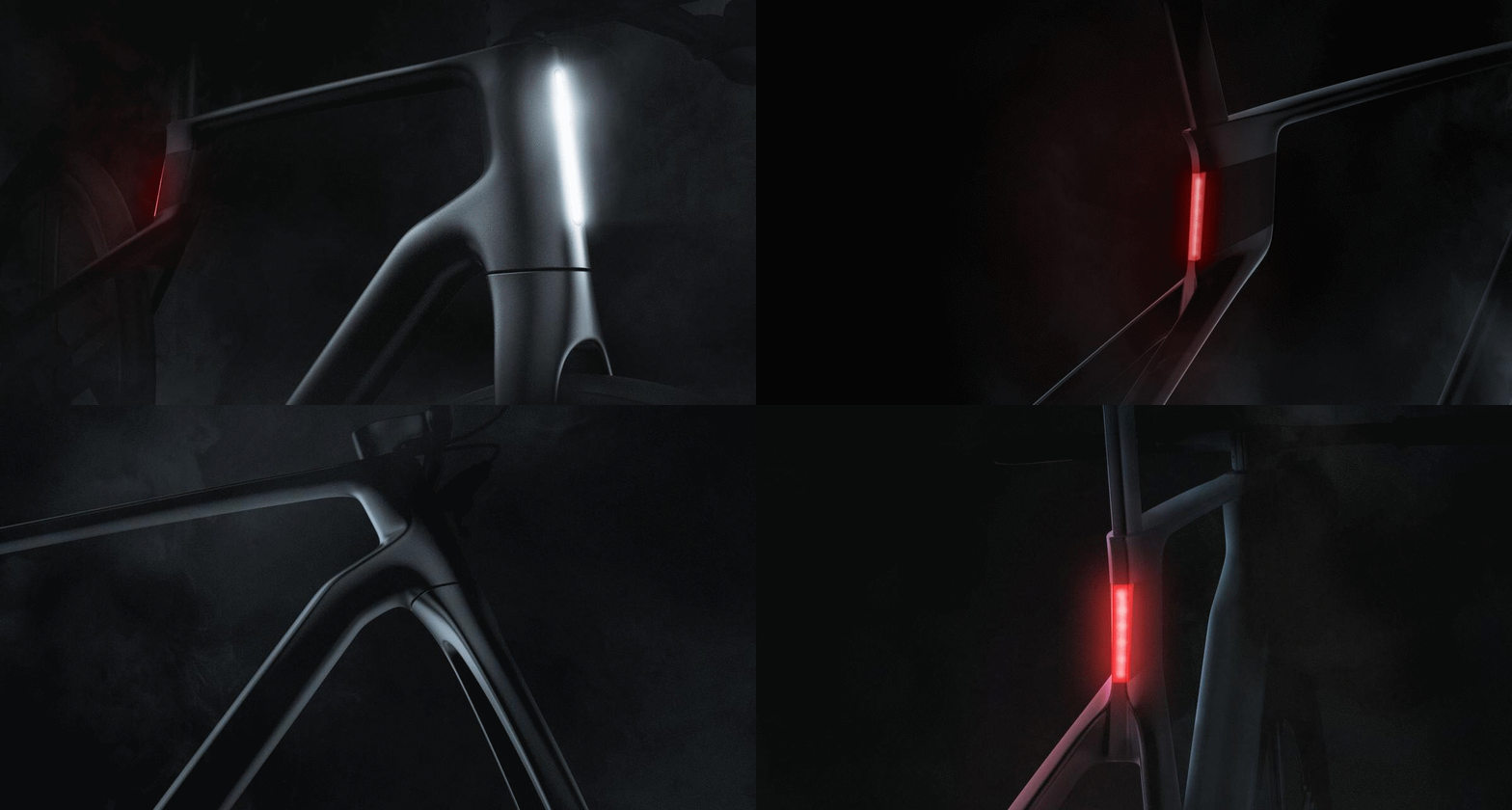
as can be seen from the accompanying images, the bicycle is relatively unusual in that the seat tube is conspicuous by its absence. that means a second bottle cage might be out of the question, and it could be a bit of a struggle to fit a front gear mech. the unibody construction is printed in a single pass of continuous carbon fibre thermoplastic composite. that means no joints or glue, resulting in seamless strength from front to back. the construction material is reckoned to be highly impact resistant, while remaining impressively lightweight.
the standard, road-going terra will retail at $2,799 (£2220) and the ion e-bike is priced at $3,999 (£3170), with delivery commencing in december of this year. both options are currently available for pre-order.
monday 13 july 2020
 ..........................................................................................................................................................................................................