
..........................................................................................................................................................................................................
nostalgia ain't what it used to be
it's strange quirk of physics that, for any given diameter, a tube will prove stronger than a rod. this is particularly applicable to the humble wheel axle, where the quick-release version as well as the more recently developed 'thru-axle' will, hands down, prove more resilient than the old-style solid, nutted axle. this is particularly true when considering the steady increase in the number of sprockets afflicting that of the derailleur-based rear wheel.
if memory serves correctly, the freewheel system topped out at eight-speeds, with shimano's seven-speed cassette presaging the death of the threaded freewheel. regarding the latter, any axle, whether hollow or solid, was effectively unsupported once it left the safety of the drive-side of the hub. between the hub bearings and the frame dropout, there was nothing that might strengthen its resolve. shimano's freehub was designed to end the calamitous breakages that often resulted from an overloaded touring bike, by placing a third set of bearings on the outboard end of the freehub.
of course, that may well have been a by-product of the cassette system which then offered the more intrepid cyclist a simple means of adapting their gear ratios to suit the terrain du jour. if moving from flat ground to hillier topography, a 21 tooth large sprocket could be easily removed in favour of something larger. disappointingly, shimano pulled the rug from under their own feet by inventing hyperglide, a series of ramps and tooth profiles featured on the cassette sprockets designed to allow changing under load without the usual cacophonous crunching of gears. since each of these ramps required to match the sprockets on each side, no longer was it possible to vary each individual sprocket at will.
riders of sram's red system will doubtless be aware that the cassette supplied is machined from a single billet of alloy.
this faffing at the rear of the bike was accompanied by faffing of a different hue at the front, namely, indexing, whereupon shimano leveraged ratcheting expertise gained from their fishing rod division and applied it to gearchanging. early versions of this in both road and off-road guise, featured the ability to resort to friction shift, should anything untoward happen to the gear mech, but in similar fashion to replaceable sprockets after the introduction of hyperglide, this unceremoniously disappeared within about a year.
my son, currently in his mid-twenties, started cycling just over 18 months ago and has thus never experienced the joys of either downtube levers or friction shifting, a situation that is probably true of the majority of today's riders. soon, there will be an entire generation of road-riders who have no idea that ther were times when gearchanging didn't require a battery.
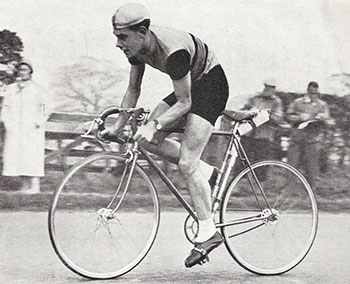
though i'm not normally one for nostalgia, i recently read a short, self-published and not commercially available book, (written by my good friend, mike breckon), about billy holmes, a rider of no small repute in the 1950s and 60s. a successful time-triallist as well as a road-racer, at the age of only 21, billy was faster than anyone at the time over the 25 mile and fifty-mile distances. the race bikes ridden in those days were the archetypal ten-speed racer with brake cables that exited the top of the levers and gearchanging that had need of being accomplished by the downtube levers mentioned above, while time-trialling was more often restricted to single-speed or a fixed gear.
having just returned from a bit of a slog into a headwind that diverted the ferries and rain that made my kneecaps cold, i have a self-satisfied glow about me that says "yes, i rode my bike in that", accompanied by a personal psyche that has me classified me as a bit of a hard man. sadly, reality scarcely bears witness to that thought. however, in this motor-car obsessed modern society, there is a credibility to be paid lip service to, for at one time, riding stupid distances in harsh weather would have been viewed more leniently than is currently the case.
if i might quote a passage from mr breckon's admirable text (with his permission):
"His (Billy Holmes') Hull Thursday Club was organising a 25-mile time trial on Bill's home roads. His only problem was that they were 240 miles from where he was doing his National Service.
"He was able to get approval for a weekend off from duties and on Friday afternoon Bill left his camp south-west of London, then set off to cycle 240 miles home to Hull which he achieved in twelve hours."
in true boys' own fashion, he not only competed over the distance come early sunday morning, but took two seconds off the course record, clocking 55 minutes 49 seconds. i doubt that sort of exploit is particularly common nowadays
those were the days when club cyclists thought little of riding 60 miles each way to compete in an amateur time-trial, with their race wheels fastened to the front forks. granted, there was often little alternative; car ownership was nowhere near as prevalent as it is now and i daresay if the motorised option had been available, it would not have been discarded in favour of a lengthy ride. however, that is not to minimise the feats of derring-do performed by 'average' club cyclists in those bygone days of yore.
bowmore village is almost exactly one mile from end to end and a substantial number of its residents drive to work. and folks wonder why the national health service is overstretched, type two diabetes is on the increase and we appear to have an obesity crisis on our hands.
sunday 14 january 2018
 ..........................................................................................................................................................................................................